

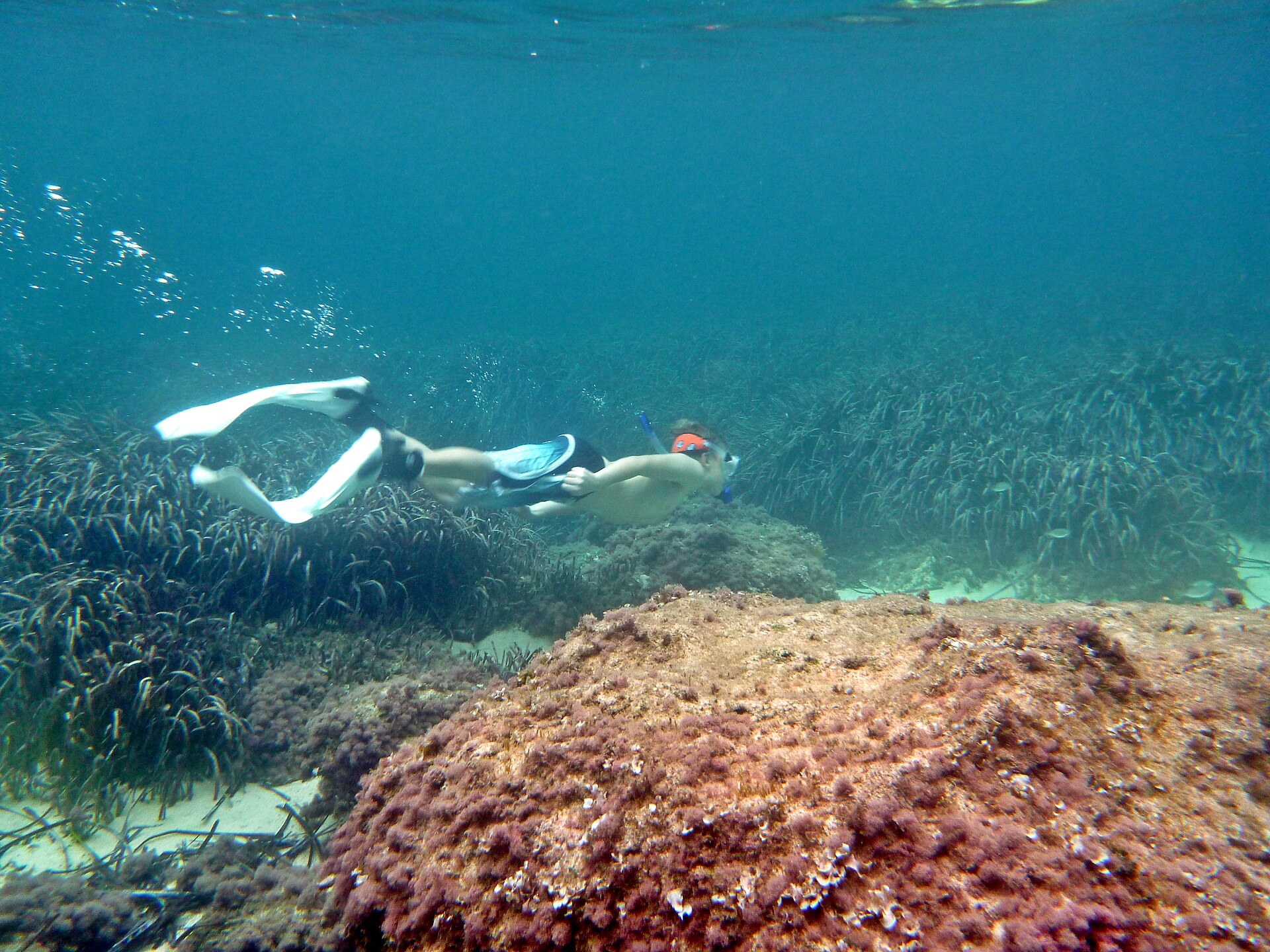
Formentera is one of the best places in the Mediterranean for diving, for a simple reason: the water is exceptionally clear thanks to the posidonia seagrass meadows that surround the island. There are dives for every level, from shallow try dives to wrecks and walls deeper than 30 metres, and the best season runs from June to October, when the sea is above 22-23 °C. If you've never dived before, the easiest way to start is a try dive with one of the island's dive centres, or simply a mask and snorkel from the shore.
We love diving. We've done it quite a few times, in L'Estartit, in Brazil and here in Formentera, although now, with our girls, we have less time for it. Here's what you need to know, from our house in La Mola and based on the official diving guide published by the Consell de Formentera.
Why the water in Formentera is so clear
It's all down to posidonia, a marine plant (not a seaweed) that forms huge meadows on the sandy seabed around Formentera and Ibiza. It filters and oxygenates the water, slows beach erosion and shelters a huge number of species. The posidonia meadows in this area are part of the UNESCO World Heritage Site.
So when you dive or snorkel, rule number one is not to touch it or stand on it, and never to anchor on it.
Formentera's dive sites
The Consell de Formentera publishes a diving guide with twelve sites. Six are along Formentera's own coast, almost all in the west, near La Savina:
- Punta Pedrera (down to 29 m): the remains of an old fishing boat at about 26 m, with moray eels, groupers and bluefish; a wall and a posidonia platform with starfish, sea urchins and octopus.
- Es Banc (down to 21 m): a vertical wall with caves and crevices, groupers and nudibranchs, and a window-shaped arch where seahorses sometimes appear.
- El Arco (down to 22 m): a large arch running from 1 to 8 metres deep and a narrower one at 15 m, with gilthead bream, salema and groupers.
- Punta Gavina (down to 23 m): next to an old watchtower; a vertical drop-off with yellow anemones and two pinnacles forming a canyon.
- Punta Rasa caves (down to 14 m): on the west coast, before Cala Saona; two caves, one about 20 metres across. You'll need a torch.
- Punta Prima (down to 28 m): large boulders on the sand, with groupers, brown meagre, octopus and cuttlefish.
The other six are in waters closer to Ibiza, and dive boats also go there from Formentera. The best known is the Don Pedro, a cargo ship over 140 metres long lying between 24 and 45 metres deep, for experienced divers only. Going inside the wreck requires specific training.
Try dives, courses and dive centres
If you've never dived, the way to start is a try dive: a short, shallow dive, always with an instructor. The island's dive centres also offer certification courses (Open Water and beyond), specialities such as photography or nitrox, and courses for children, which take place at about 2 metres deep under close supervision.
The Consell's official guide lists three centres: Formentera Divers, Vell Marí and Orcasub. We don't know them personally, so we'd suggest asking about group sizes, levels and times before booking, especially in July and August.
The Es Freus marine reserve
Between Ibiza and Formentera lies the Es Freus Marine Reserve, covering more than 13,600 hectares: the second-largest marine protected area in the Spanish Mediterranean. It includes the north-west of Formentera, the strait between the two islands and islets such as s'Espalmador. According to Formentera's official tourism website, anchoring, spearfishing, recreational fishing and scuba diving are prohibited in the reserve.
In practice, this means dives are organised at the permitted sites and the dive centres know where you can go. If you're going independently, check beforehand.
How to dive responsibly
The Consell's own guide sets out a few simple rules:
- Moor to buoys where there are any; otherwise anchor only on sand, never on posidonia or rock.
- Control your buoyancy so you don't touch the bottom or kick up sand with your fins.
- Don't touch, chase or feed the animals, and don't take anything living: a photo is better.
- Don't linger inside caves or under arches: your bubbles harm the organisms living on the ceiling.
- Pick up any rubbish you see, especially plastic.
When to dive in Formentera
For pleasant water, from June to October: the sea is around 23 °C in June, 26-27 °C in July and August, and still about 23 °C in October. In May it's around 19 °C and you can dive with a good wetsuit. We go through it month by month in our post on Formentera weather.
The wind decides: with a heavy swell, the centres switch sites or cancel the trip. There's usually a sheltered side of the island.
Snorkelling: the easiest way to start
If you don't want to scuba dive, a mask and snorkel are enough to see fish and posidonia meadows a few metres from the shore, especially in rocky coves with calm water. From La Mola, the coves of Es Caló and Ses Platgetes are about 10 minutes by car, and they're a good choice on days when the south coast has waves.
From our house
Most of Formentera's dive sites are on the west coast, near La Savina, about 25 minutes by car from our house in El Pilar de la Mola. You can dive in the morning and be back for lunch or the pool. Can Javi de Palma is our family home in La Mola, with three double bedrooms, a private pool and a garden, for up to six adults (tourist licence ET6047). If you fancy coming, you can check availability here, and you'll find more trip ideas on our Formentera island page.
FAQ
Can you dive in Formentera without a certification?
Yes, with a try dive: a short, shallow dive, always accompanied by an instructor from a dive centre. To dive on your own you need a certification.
What is the best time to dive in Formentera?
From June to October, with the sea between 23 and 27 °C. September is usually a great month: the water is still warm and there are fewer people.
Can you dive in the Es Freus reserve?
According to Formentera's official tourism website, scuba diving is prohibited in the marine reserve, as are anchoring and fishing. The dive centres know which sites are permitted.
Can children dive in Formentera?
The centres offer courses for children at about 2 metres deep, with an instructor keeping a close eye. For the youngest, snorkelling from the shore is the best way to start.
Header photo: snorkelling over a posidonia meadow in the Balearic Islands. Author: Wusel007, Wikimedia Commons, licence CC BY-SA 3.0.

